You can install it in your device (cell phone or computer)!
I recommend Installing it because you'll have a better experience: notifications when there's new content, direct access from your home screen, and faster loading times.
Kago
Project sheet
Year
2026
Status
Type
Compression utility
Platforms
Any MSX computer running MSX-DOS2 or Nextor
License
Apache License, Version 2.0
Project URL
Programming language
Z80 assembly
Summary
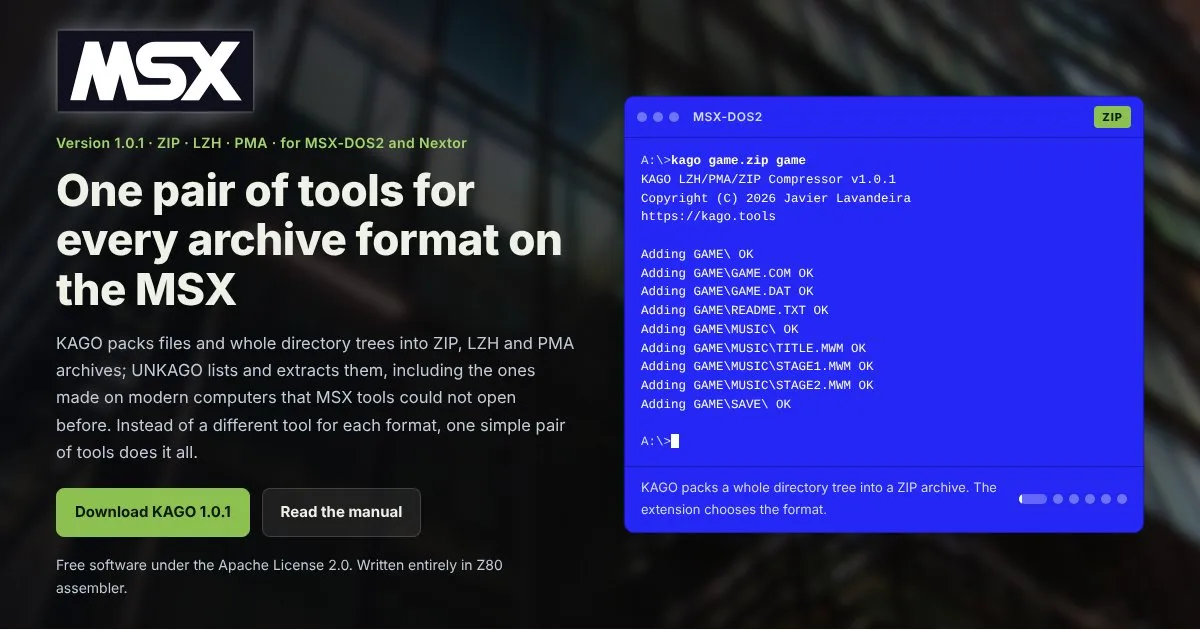
Kago is a pair of archivers that I wrote for MSX computers: one simple pair of tools that creates and extracts ZIP, LZH and PMA archives, including whole directory trees. They run on the MSX itself, under MSX-DOS2 or Nextor, and they also open archives made on Windows, macOS or Linux. Both programs are written entirely in Z80 assembler, and are distributed for free under the Apache License 2.0, with a manual in English and Japanese.
Description
The package contains two programs: KAGO, the compressor, and UNKAGO, the decompressor.
KAGO packs files and directories into a new archive, or adds them to one that already exists. UNKAGO lists an archive, and extracts all of it or only the files you choose, into the current directory or anywhere else.
You don't need a different tool for each format. KAGO takes the format from the archive's name (.ZIP, .LZH or .PMA), and UNKAGO recognises the format by itself.
Why I Wrote It
Convenience. Until now there was no archiver for the MSX that supported directories. Support for ZIP files was rudimentary: only a tool or two could handle them, and only partially.
The most popular archiver on the MSX has always been PMext. It was developed for CP/M in 1990–1991, and it extracts .PMA files and some of the older kinds of .LZH archive, but it has no support for directories. Any time I wanted to move a project with subdirectories between one of my MSX machinesand another computer, I had to flatten it first, or copy the files one by one, or do all the unarchiving on the other computer... a pain in the ass, as you can see.
With Kago, we can now create ZIP files on the MSX, subdirectories included, and extract ZIP files created on other computers. Moving files between an MSX and a modern machine is much easier. UNKAGO also reads the -lh6- and -lh7- LZH archives that lha writes today, which older MSX extractors can't open.
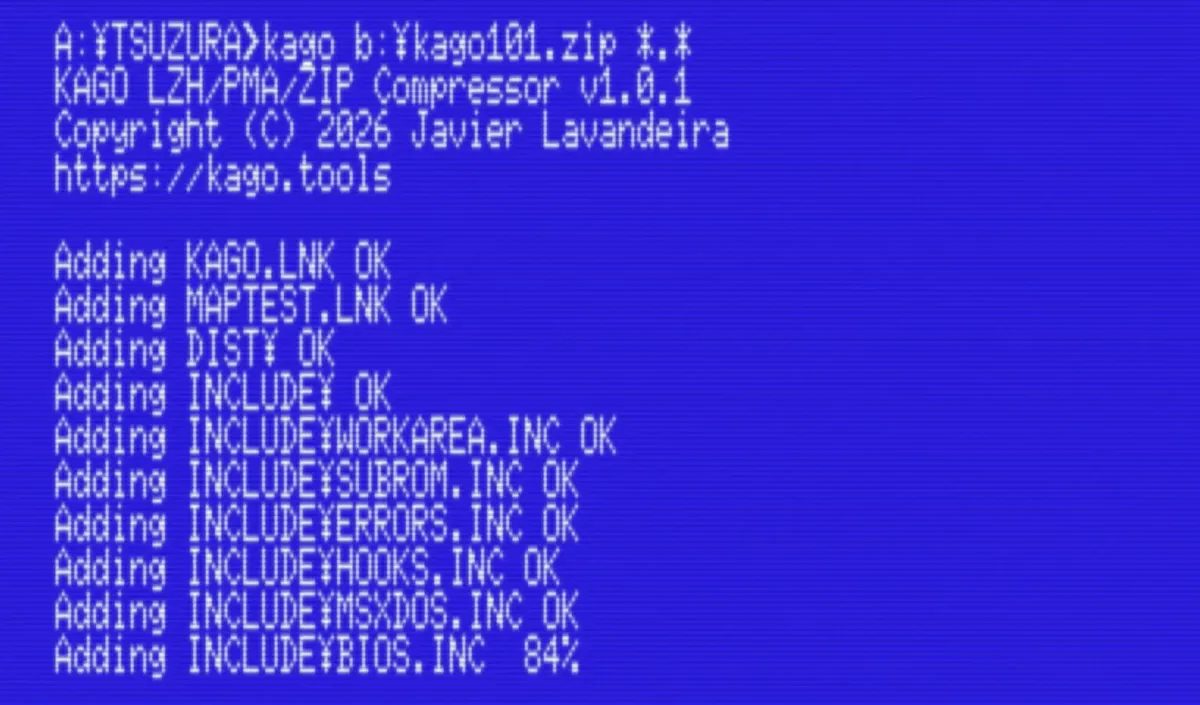
The tools are written in Z80 assembler, not C, so they run a bit faster than other MSX tools. Of course, they are still slower than compression tools running on modern hardware (especially if you're using an MSX2 or MSX2+). What matters is that they let us handle files we simply couldn't use on the MSX before.
The Name
A kago (籠) is a basket: something woven of bamboo or rattan that you put things into, and take them out of again. KAGO puts the files in; UNKAGO takes them out. The mark on the website is the weave of the basket's strips, over and under.
Features
- One pair of tools for three formats: ZIP (deflate), LZH (-lh5-) and PMA (-pm2-)
- Whole directory trees, packed and extracted, in ZIP and LZH archives
- Opens archives made on modern computers: ZIP files from Windows, macOS or Linux, and -lh6- and -lh7- archives from lha
- Reads PMarc's -pm1- and -pm2- archives, including self-extracting .COM files, without running them
- Writes PMA archives that PMEXT can extract
- Shortens long filenames to MSX-DOS's 8.3 form the way Windows does: longfilename.txt becomes LONGFI~1.TXT
- Adds files to an existing archive, in all three formats, replacing files with the same path
- Safe extraction: checks disk space and memory before writing anything, checks every file's CRC, and never overwrites a file unless you ask
- Extracts only the files you choose, with wildcards, into any directory, created if missing
- Keeps each file's date, time and attributes
- Uses whatever mapper memory is free; with less than it needs, KAGO packs with a smaller window, or stores the files, after asking
- Runs on any MSX2 or later with MSX-DOS2, and faster in the turbo R's R800 mode
Built on the MSX
Both tools were assembled and linked on the MSX itself, with Tatara, my macro assembler and linker. The archives they write are checked against lha, zip and PMarc as references.
Documentation
The KAGO and UNKAGO user's manual describes every switch, format and message, in English and Japanese. The website also has a page of examples showing each tool at work, with the full output of every command.
- Kago website: https://kago.tools/
- Online manual: https://kago.tools/en/manual/
- Examples: https://kago.tools/en/examples/
License
The software is released under the Apache License, Version 2.0.